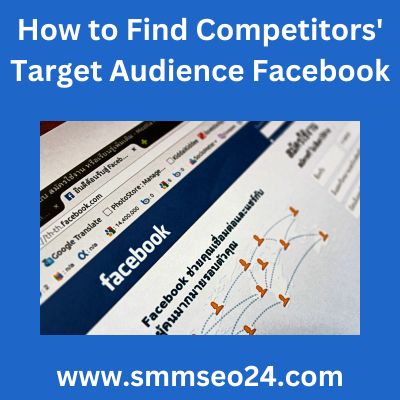
The best way to find competitors’ target audience on Facebook is to study their active ads, offer, creative, comments, and landing pages together. Don’t rely on a single ad or guess from a competitor’s follower count.
SMM & Reputation Growth
Grow Your Brand Online — Faster
Boost your social media presence and build a stronger online reputation with SMMSEO24. Trusted by businesses across the US.
- Fast Delivery
- 24/7 Support
- Secure Checkout
Your answer will change based on the competitor’s activity, the market you serve, and whether Meta shows enough public ad data. You’ll also need to separate the people a competitor reaches from the people who actually buy.
Who Finds Competitors’ Target Audience?

A new advertiser may have a product, a Facebook Page, and no clear customer profile. They need useful clues about age, problems, offers, and content angles before spending money on ads.
An established business may already know its buyers but want to enter a new market. It needs comparison data: which customer problem competitors focus on, what promises they repeat, and where their ads send people.
An agency or marketing team may need a faster way to build research notes for several brands. It needs a repeatable process, saved evidence, and a clear line between public facts and educated guesses.
This page serves best if you can view public Facebook and Instagram ads and inspect competitor websites. It assumes you’re researching legal, public information—not trying to access private audience lists, personal data, or another company’s advertising account.
If you need exact customer identities, private email lists, or hidden targeting settings, use your own customer research instead. Competitor research can show patterns, but it can’t reveal a competitor’s full customer database.
What changes the audience picture?
The competitor’s active ads matter most. Meta’s Ad Library lets you search ads that are currently running across Meta products, so start there rather than with old screenshots. Search the brand name, product name, and common spelling variations.
The offer reveals who the ad is meant to attract. A discount for first-time buyers points to a different audience than a premium consultation, wholesale offer, or replacement product. Record the price language, promise, and action the ad asks people to take.
The creative gives clues about the buyer’s problem. Look at the words in the headline, the person shown, the setting, and the pain point. A parent-focused image, a business-owner message, and a hobby-based demonstration may sell the same product to different groups.
The landing page is often the strongest check. Compare its headline, testimonials, product bundles, FAQs, and form fields with the ad. The mistake people get wrong most often is treating likes or comments as proof of buying intent; that can send you toward a large but unprofitable audience.
Finally, check repeated patterns across several ads. If one message appears once, treat it as a test. If the same problem and promise appear across different creatives, treat them as a stronger working hypothesis—not a confirmed fact.
How to research competitors’ target audiences on Facebook
Start with the public ad evidence, then compare it with the competitor’s offer and website. The process below is for research, not for copying ads or attempting to identify individual users.
-
List 3–5 direct competitors. Choose brands selling a similar solution to the same type of buyer. Confirm each one has a matching product, service, or customer problem before adding it to your list.
-
Open Meta’s Ad Library and search each brand. Use the brand’s exact name first, then search its product names and website domain. Record the country, platform, ad status, headline, and first visible date when those fields appear.
-
Save 5–10 relevant ads per competitor. Save ads that promote the same product or customer problem. If a competitor has fewer than 5 relevant ads, mark the sample as small instead of filling the gap with unrelated ads.
-
Group the ads by customer problem. Use plain labels such as “saving time,” “reducing cost,” “looking better,” or “learning a skill.” Keep one label per ad unless the message clearly serves two different problems.
-
Record the offer and next action. Note the price wording, discount, free trial, lead form, product page, booking page, or message button. The action tells you how much commitment the competitor expects from that audience.
-
Read the landing page beside the ad. Compare the page headline, proof, product details, and questions. The step worked when the page clearly supports the same problem and promise shown in the ad.
-
Review comments for repeated questions. Count themes, not people. Note questions about price, delivery, fit, results, timing, or setup, but don’t copy names or personal details into your research file.
-
Build audience hypotheses. Write a statement such as, “This offer may target small-business owners who need faster scheduling.” Add the evidence beside it and label it as a hypothesis.
-
Compare your own customer evidence. Check sales calls, support questions, search terms, and customer reviews against the competitor pattern. If your evidence disagrees, test both groups instead of choosing the larger one.
The key judgment is deciding what counts as repeated evidence. If the same problem, offer, and audience language appear across several ads and the landing page, use it as a testable direction; if they appear only once, keep it as a weak clue.
Stop before scraping private data, bypassing access controls, or buying personal information. A privacy professional, attorney, or qualified compliance adviser should handle any research that could identify individuals or use data beyond public advertising.
Facebook audience research by situation
Use the row that matches your research goal, and keep weak evidence separate from stronger repeated patterns.
| Situation | What to do | What it takes | What to watch for |
|---|---|---|---|
| New competitor | Search brand and products | 20–30 minutes | Small ad sample |
| Several active ads | Group repeated messages | 30–60 minutes | Tests look permanent |
| No active ads | Study offer and website | 15–30 minutes | Old evidence missing |
| Local competitor | Check location wording | 20–40 minutes | Region changes demand |
| B2B competitor | Read lead-page language | 30–60 minutes | Buyer and user differ |
| Similar products | Compare customer problems | 30–45 minutes | Features hide motives |
| High-value service | Study booking path | 45–90 minutes | Few ads may convert |
Details that improve the result

Keep evidence separate
Use one research row for each ad, not one row for each competitor. Record the exact wording, visual idea, offer, landing-page type, and customer problem. Add the date you viewed it because ads can stop, change, or return later.
Don’t turn an ad’s design into an audience fact. A photo of a young person doesn’t prove the ad targets a young audience. Treat the image as a clue, then check whether the copy, offer, and landing page support the same idea.
Test the useful difference
Experienced research compares message angles, not just brands. If one competitor sells speed and another sells lower risk, test those promises against your own customer evidence rather than copying either one.
There’s a trade-off between speed and confidence. A quick review of 2–3 ads can give you a direction today, but a larger comparison across several ads, pages, and customer questions gives you better confidence at the cost of more time.
Leave private targeting assumptions alone. Meta may show public ad details without showing the advertiser’s complete audience settings. If the information isn’t visible, write “not shown” instead of guessing.
Facebook audience research mistakes
A weak result usually comes from confusing visible activity with profitable demand. Use the table to match the warning sign with the safest first fix.
| What you notice | What it usually means | What to do first | How to stop it happening again |
|---|---|---|---|
| Many likes, few clues | Engagement isn’t buying proof | Read comments and offer | Track intent separately |
| One ad drives conclusions | Evidence sample is too small | Find related ads | Label weak hypotheses |
| Copy is copied exactly | Brand voice gets lost | Extract the problem | Write your own promise |
| Old ad is treated current | Market message may change | Check active status | Add research dates |
| Broad audience assumed | Product fit is unclear | Read landing page | Compare buyer questions |
| Comments copied personally | Privacy risk increases | Remove identifying details | Store themes only |
| Competitor’s price copied | Costs and positioning differ | Compare your economics | Set your own offer |
The costly mistake is copying a competitor’s audience label without checking your own conversion path. You may pay to reach people who like the topic but don’t need your product, while missing a smaller group with stronger buying intent.
Rules for using competitor data
Meta’s public Ad Library is useful for viewing ads, but it doesn’t give you permission to copy creative, trademarks, testimonials, or private customer information. Use public ads as research evidence, then create original wording, images, and offers. You can review Meta Ad Library details for the public fields available in your country.
Privacy rules vary by country and by the data you collect. The Federal Trade Commission publishes US guidance on advertising and consumer protection, while the European Data Protection Board publishes guidance for organizations handling personal data in the European Union.
Don’t collect names, profile details, screenshots of private accounts, or personal contact information just to build an audience guess. If your plan involves matching customer data, retargeting, or sharing information with a platform, check the relevant privacy notice, consent basis, and business terms first.
Stop and get qualified legal advice if the research involves children, health information, financial details, employment data, or individual-level tracking. The public nature of an ad doesn’t remove every legal duty connected with how you store or use your notes.
The real cost of audience research
A basic competitor review costs time before it costs money. One brand with a small ad set may take about 20–30 minutes to review, while several brands with different offers can take 1–2 hours each. The actual time depends on the number of ads, markets, and landing pages.
The larger cost is a bad decision. If you mistake attention for buying intent, you can spend your test budget on people who engage with content but don’t complete the action that matters.
You can lower costs by recording only evidence tied to a decision. If it changes none of these, leave it out.
Competitor audience quality varies with the product, market, and sales process; find your exact figure from lead quality, conversion rate, and customer fit—not from ad counts alone.
Keep your research useful
Store your notes in a dated spreadsheet or document with separate columns for competitor, ad, problem, offer, evidence, and hypothesis. Keep the original wording short, and record the page or ad reference needed to find it again.
Review the file when a competitor’s message, offer, or landing page changes. A new discount, new customer problem, or new call to action is a sign that your old audience assumption may need another check.
When your test produces poor leads, don’t throw away the whole file. Mark which hypothesis failed, keep the evidence that still matches the market, and change one major variable at a time so you can see what improved.
When Facebook research isn’t enough

This method isn’t for finding private individuals or exact personal targeting lists. Use customer interviews, consented surveys, or your own first-party analytics when you need direct information about people’s needs.
It’s also the wrong choice when a competitor has no active ads and a weak public website. Use category research, search data, sales conversations, and support records instead of treating missing evidence as proof that no audience exists.
Don’t rely on it alone for regulated products, children’s services, medical claims, financial offers, or political advertising. Use the relevant compliance team or attorney before launching, because public competitor ads don’t prove that their claims or targeting are lawful.
Frequently asked questions
Can I see who a competitor targets on Facebook?
No, not completely. You can see public ad details and infer likely audience problems from the copy, offer, creative, and landing page, but Meta doesn’t give you the competitor’s full customer list or every targeting setting through public ad viewing.
Why can’t I find my competitor’s Facebook ads?
The competitor may have no active ads in your selected country, may use a different business or product name, or may be advertising only on another Meta placement. Search the brand, product names, and domain, then check the country setting.
How long should competitor audience research take?
Allow 20–30 minutes for one competitor with a small, clear ad set. Allow 1–2 hours when you’re comparing several markets, offers, landing pages, and customer problems. The number of relevant ads and pages is what changes the time.
Is it safe to copy a competitor’s Facebook audience?
No. Copying a competitor’s audience assumptions can waste budget, and copying their creative, claims, testimonials, or private data can create legal and platform problems. Use their public messages as clues, then test original positioning with your own evidence.
What happens if a competitor has no active Facebook ads?
You’ll have less current evidence, not proof that the competitor lacks an audience. Study its public offer, website, reviews, and customer questions, then compare those clues with your own sales or support data before creating an audience test.
Does Facebook show competitor ad results?
No. Public ad views don’t show the competitor’s complete reach, sales, conversion rate, or profit. Treat repeated messages as hypotheses and judge your own test with qualified leads, purchases, or another clearly defined business action.
How many competitor ads should I study?
Start with 5–10 relevant ads per competitor when that many are available. If fewer exist, record the smaller sample and lower your confidence. More ads help only when they represent different messages or offers, not duplicate versions of one campaign.
Start your Facebook audience research
Begin by listing 3–5 direct competitors and recording their active public ads, offers, and customer problems. You should finish with testable audience hypotheses, not a claimed fact about who buys. Stop and get help if the work requires private data, regulated claims, or individual tracking.

WRITTEN BY